
Episode #423

Millions of people recognize Scott Rogowsky as the original host of HQ Trivia, the daily live trivia app that became massively popular in 2017 before fizzling out in 2019. CNN looked back on that phase of Rogowsky’s life in the 2023 documentary, Glitch: The Rise & Fall of HQ Trivia. But I first met Scott when he was barely out of college, one of the young upstarts in the downtown New York comedy scene in the late oughts. So we enjoyed a fun stroll down memory lane, as Rogowsky reflected with me on how his internship with The Onion led him down a path that included making viral videos with Playboy, a sports talk show with the future editor-in-chief of Vulture, to his own talk show, “Running Late with Scott Rogowsky,” all the way through HQ to his current life in southern California, where he runs his own vintage clothing and sports memorabilia shop, Quiz Daddy’s Closet, in Santa Monica.
Want to discover other cool Substacks? Each morning, The Sample sends you one article from a random blog or newsletter that matches up with your interests. When you get one you like, you can subscribe to the writer with one click. Sign up here.

If you’re not already subscribed to my podcast, please seek it out and subscribe to Last Things First on the podcast platform of your choice! Among them: Apple Podcasts; Spotify; Stitcher; Amazon Music/Audible; iHeartRadio; Player.FM; and my original hosting platform, Libsyn.
This transcript has been edited and condensed only slightly for your convenience.
How do you feel about how the CNN documentary turned out?
I think they did a good job with it. You know, contrary to what some of the Internet might believe, I had nothing to do with the production or direction or editing or anything to do with the documentary — other than appearing in it. So if there are people who are upset about certain people being left out, or certain narratives not being told — it was NOT my call, not my fault. Take it up with the director and the production company. I was a little nervous actually. I was hesitant to do it, because I’d already talked so much about it. And then once I interviewed. I mean, the interview process, you want to go behind the scenes, was a bit of a nightmare. And God bless, I know a lot of hard people worked on this thing. But they picked an AirBnb in Brooklyn to shoot this interview and it was the thinnest walls in Brooklyn. For whatever reason, I guess we were too close to JFK. There were planes going overhead, and every five minutes we had to stop down for planes. She’d asked me some question like, ‘What was it like to have your friend and boss overdosing on drugs?’ I’m trying to get this emotional story out, and all of a sudden, STOP. Cut. And I had to reset my story all the time. So that part of it was not the most fun and a little frustrating. And then, when you do these things, even talking to journalists, you never know how your words are gonna be twisted or used or especially with a documentary, you know, I think back to the famous Simpsons Hard Copy parody, with Homer saying ‘sweet, sweet can,’ and how they recut his interview. So it’s like, you know, once you do this thing, it’s fair game. They can chop it up however they want.
My hope was, and it turned out to be true is that you know, this is CNN. There’s some journalistic standards they have to adhere to, they’re not going to take things out of context or really mangle my intention. So I was pleased with how that came out. There were a few instances where I thought they could have let me talk a little more, let me finish the thought or close the loop on some things. But it’s an hour and 28 minutes. I probably gave them enough material in there to go double the length. All in all, I probably gave them six to eight hours. Don’t get me wrong here. I’m glad I did it. I’m glad I got the story out and I’m very thankful to Salima, the director, and Left/Right, the producers who really I think did a fine job all in all.
That final shot though of you blowing leaves outside of Quiz Daddy’s, such a poignant ending.
My one critique of that whole ending is: So you’ve got the whole, Where are they now?, which you know, it’s a nice tidy wrap-up to a documentary and you see my story. How about everybody else who worked on the documentary, and especially how about Rus (Yusupov)? Where’s Rus today? He was the other — Colin, we know where he is, unfortunately. But where is the other main character in this thing? I frankly don’t know.
What’s going on with the other hosts?
Exactly! What’s going on with the other hosts? I mean, everybody who worked on the show on HQ, and the other hosts included, they’ve all gone on to do great things and they’re they’re all finding success, which is great. I know that. But the audience doesn’t know that. So I thought that could have been included. But again, it’s hard to pack everything in.
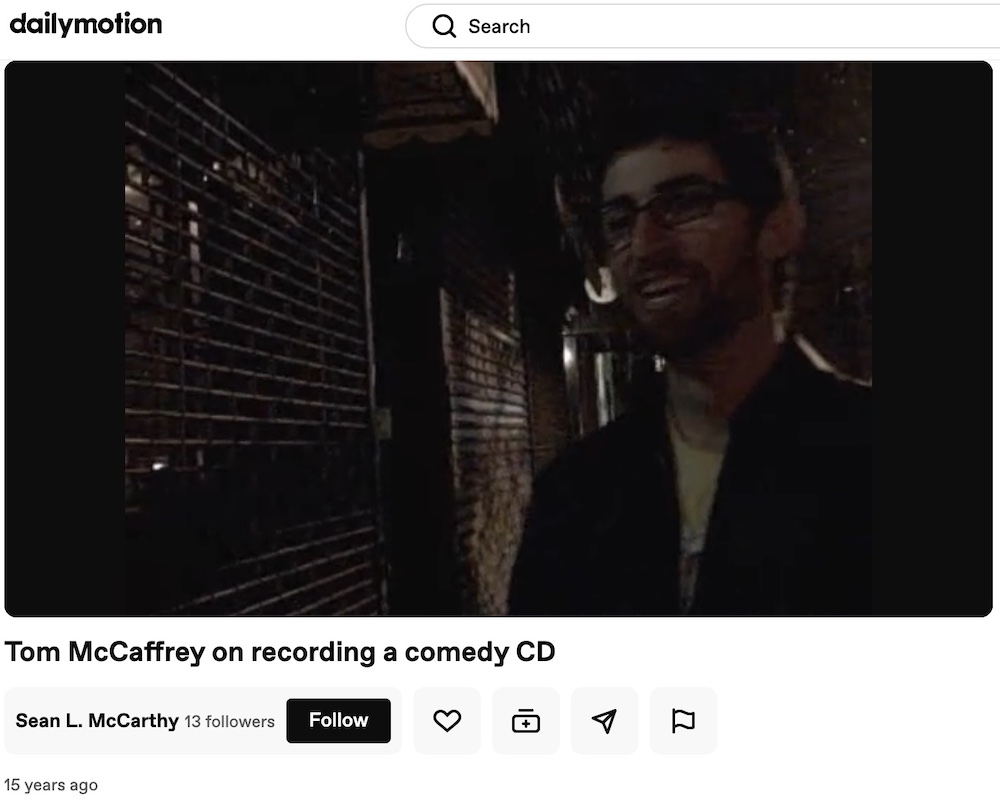
I didn’t realize that you were fresh out of college, the first time I met you that in the winter/spring of 2008, outside of Rififi, where you had this idea to launch your own comedy record label. And you were gonna start by making an album with Tom McCaffrey. And you’re explaining this to me outside Rififi.
Long live Rififi.
And I was like who is this guy and what is happening here? I didn’t realize you had just graduated from college.
I mean, at that point, I guess I’d been a year out of school and I was interning at The Onion.
And I had just been immersing myself in the comedy scene in New York and trying to get up as much as possible. Meeting all these incredible people and performers, and McCaffrey was one of them. I was just blown away by this guy and I couldn’t believe like, I’m seeing David Cross and Michael Showalter, Janeane Garofalo, Reggie Watts. You’re seeing a lot of these people who are established, and maybe Reggie wasn’t quite established at that point. But people who had careers going strong, managers, agents, the whole nine yards and here’s this Tom McCaffrey guy, I thought was just as every bit as funny as the rest of the comics I’ve seen but I’d never really heard him. I’d seen I guess his Premium Blends, but I was aware that he had done some things that Comedy Central but he wasn’t repped. He didn’t have any albums, and I thought that was a crime. So I just approached him, me being a 23-year-old, kind of a naive kid just thinking I remember actually talking to my dad about this. We were down in Florida at some point, on some family vacation, and I was just kind of walking on the beach of them and I said, Hey, I think I want to produce this guy’s album and it’s gonna cost you know, this amount of money. It’s like, I didn’t have a lot of my time and he’s like, Look, if you think this is something that you believe in, go for it. He supported the decision. It ended up being like probably $2500. I partnered with my buddy Travis Sluss, who was the recording engineer. Because I didn’t know anything about that. But I had the idea and I booked the venue and I set up, booked the opening acts and get the poster, do the all the things of producing, and I like producing. Even designing the CD album art and putting together the whole CD cover which is such an anachronistic thing to even think think about now, CDs. But I still have about 400 of the CDs in my parents basement, actually, if anybody wants a free copy, hit me up. I’ll gladly send you one, media mail.
You should sell them at Quiz Daddy’s Closet.
I should, right? I don’t know. Certainly, coming up on 15 years that’s technically vintage. So no, it was a great project and Tom was very thankful to have it and all in all, I made the money back. I mean, from a financial perspective, it all worked out. And Tom’s happy he’s got this record. He ended up doing a couple more albums after that, but, you know, I did not release another record on the label.
I was about to say…
Timing is so important in life, and it was 2008. We’re kind of at that crossroads where like, CDs were sort of being phased out. Streaming wasn’t quite where it was. Now, you don’t even need to do CDs. If you’re going to produce an album. I would say you don’t make a CD. You just put it out on Spotify and it’d be a lot easier, frankly. But you know, Travis got busy. And a lot of that comes down to then the recording aspects. So now it’s really all on who’s going to record the show and engineer the show, mix the show and all that, and that those aren’t my strong suits. It just ended up being that one project but we’re very proud of it. It was highly reviewed, critically adored, and I think it still gets play on SiriusXM stations — there are still quarterly, very small quarterly checks coming in from the royalties.
You mentioned that out of college, you were able to get an internship at The Onion. What was that like?
That was probably the most consequential thing I’ve ever done in my life, looking back on it. Because for one, The Onion was the paper of record in my mind. If I was a young journalist, this would be like giving an internship at The New York Times. This this was this was the pinnacle of comedy, written comedy in the 2000s and I was just a fan of it since you know, going back to high school years, so the fact that I can get in there. You know, it’s an internship not getting paid, but I don’t care. I mean, I’m hanging out with Carol Kolb and Joe Garden and Todd Hanson. Joe Randazzo was the editor in chief. Scott Dikkers would be around, the original founder and editor of the thing. That was a good example of timing because there was still the old guard there. It was still in New York. They moved from Madison to New York, I think in 2001. And this was 2008. So a lot of those old guys from Madison were still involved. And I’m in the mix. I was part of the ONN. So I actually applied originally for the paper internship and did not get that. But again, timing they were just launching this, ONN. Onion News Network, right? My internship was technically for the Onion News Network, the video component. And again, that was like an amazing group of people who have all gone on to so many great things. I mean, Chris Kelly was was like a locations manager scout on that thing, like you know, low, low totem pole jobs. Lang Fisher was working on that thing. They’ve gone on to become great writers and producers. Sascha Stanton Craven, he’s now doing great editing work. Dan Mirk, who’s awesome, wrote on a bunch of shows. I mean, a lot of really funny, talented people were working on that thing. Beth Newell was another intern, fellow intern of mine, she went on to found Reductress, which has become this huge thing. And I mean, that was just being in that mix, the other interns. It was exciting, like a start-up. Because this was a new thing, the Onion News Network and just to get my jokes in the scroll. They had a little ticker was like a parody of CNN. So there would will be a constant scroll with constant jokes in the bottom corner. There were so many opportunities to get jokes in, which was great. The Onion SportsDome came out of that, which then they got the Comedy Central show.
Right, they had two different TV shows going in 2011 — ONN on IFC, and Onion SportsDome on Comedy Central.
Exactly. I ended up staying the entire year. These are supposed to be like, quarterly or semester internships. I ended up doing three rounds. I said ‘Guys. I don’t want to leave. You’re not paying me, it doesn’t matter. Right? Like, as long as you’ll have me I’m gonna keep showing up.’ And I guess they had enough chairs, and they let me stay and I cycled through and just became probably the longest-tenured intern the entire year of 2008. But another guy I met there, Nick Gallo, who was the photo editor at the time — I say it’s consequential because yes, I got to meet all these people. And get my jokes published. I ended up getting some jokes paper published in the paper because I can submit to the paper and sit in on those meetings occasionally, which was just the most amazing thrill of my life, at that point, being in the room, those weekly meetings when they put the paper together, and hearing all these brilliant writers. Seth Reiss, he’s now at Late Night with Seth Meyers, John Krewson, Chad Nackers. Just brilliant, brilliant minds that are putting this thing together. To walk in one day, and to see one of my headlines had been chosen for the A story on the front page. It was like a miracle. I mean, I could not believe that that had happened, and there it was. It ended up going through, got published. I’ve framed it. I mean, that’s it. I can die happy knowing I got a page 1, A-1 story headline, which Joe Garden wrote.
Which one was it?
It’s one of those the headlines where like, it’s not as funny as the concept. The story was great that Joe wrote, but it was August 2008, the presidential campaign was heating up.

Baratunde Thurston, also there, also gone on to do great things. He’s PhotoShopped next to Obama, wearing a straw hat and moonshine, in overalls. And it’s like, you know, a Billy Carter parody. And the story was just really funny about you know, like, all of a sudden Obama’s hillbilly half-brother shows up on the campaign trail. I started to learn these things like you know, a snappy one-line, play on words, doesn’t necessarily work for that A-1 story. You’ve got to write 500 words on that story on that headline, 1,000 words — you need something meaty to work with. Anyway, I learned a lot, but then Nick Gallo, all those years later — 2008 to 2017 — he’s the guy who calls me up and says, ‘Hey, you want to come in for an audition for this game show on a phone?’ And that became HQ and that’s why I say, say yes to everything. Be nice to people. Take the internships. It may not pay them, but it will pay off down the road. This one certainly did.
Around the same time, when I first met Marianne Ways she was working at The Onion. In the opening of CNN’s HQ doc, when they talk about setting up your audition, and there’s that little imaginary text thread, and it says Marianne, I want to say that’s Marianne Ways!?
That was Marianne. You’re probably the only one to pick up on that one. I think they contracted her to do the host search. But the irony is that they didn’t go with anyone that Marianne chose. It was Nick who thought of me and brought me in, so I love Marianne a lot, but it was Nick who I have to thank for that.
Who do you have to thank for meeting Neil Janowitz?
Good question! I think it’s Gary Belsky, who was the editor-in-chief of ESPN The Magazine. Now I’m trying to think of how did I get connected to Gary Belsky.
And Neil is now the editor-in-chief of Vulture.
Exactly. I truly don’t know who it was, how it was. But I think someone connected to Gary Belsky then connected me to Neil, said to talk to Neil, and Neil and I grabbed lunch at a steak house near the ESPN office in Midtown. And it was like instant simpatico. Like wow, this guy loves sports but loves comedy and we were you know firing on all cylinders with the references and things and it was just like, you know, around the same age and it was just. I brought like all these samples that I had, you know, I was formalized. And by the end of it was like, Yeah, we should be doing a sports comedy show together. Like you’ve got the sports contacts. I’ve got the comedy contacts. And that’s what we did. We started 12 Angry Mascots in September 2008 at the UCB Theatre.
They used to have you could apply to kind of put on a show there. Dirty little secret that I will share with you that I’ve held on to for 15 years, is that the guidelines in that application say like, you should have put the show on elsewhere. This is UCB is the grand stage. You try this out in New Haven or somewhere and you bring it down to UCB. You don’t just launch a fresh show at UCB. Well, we kind of fudged the application. We said we’ve been doing it for a few months. We’d never done it before. This was our first show at UCB and they accepted it. They did not take it on. It was a one and done. We did not make make it a recurring appearance. We really didn’t have any expectations around that. We really just wanted to get it up, and get it up at a prestigious place like UCB. And then from there, it gave us the confidence to you know, started booking elsewhere. and we started independent theater nearby and then we ended up going to Comix.
Comix is where I remember seeing it.
By then, oh, UCB is on our resume now. It helps, right? So a little hack, little hack there. And Comix was great. They gave us a monthly show and Brian Baldinger back then booked that venue and we had a great run there. You know, unfortunately, the venue did not fare as well. And then we ended up going to The PIT Theatre. We did it at Gotham Comedy Club. I don’t know if we did it at Carolines. I did Running Late at Carolines. Again, it’s like once you get a few theaters under your belt and you have resume, you’ve got samples, you can propel yourself onward. So that’s what we did with 12 Angry Mascots for three years and that was a lot of fun. And then that ran out of steam.
It seems as though like from from 12 Angry Mascots to Running Late to HQ, I really got the sense that like deep down, I know you describe yourself as like an old comedy soul. You really wanted to be like a Johnny Carson or a David Letterman yourself.
Yeah, Chevy Chase Show was really what I was aiming for, or Magic Johnson Hour.
Your show lasted much longer, though!
Johnny Carson was a little before my time but I mean, I was aware of Johnny. I was really into Conan, Letterman. I just wanted a talk show. I just love the format of a talk show. I mean, Jack Paar. Steve Allen. I don’t care who’s hosting it. I thought the whole concept of a talk show is just so fun and engaging to me, if it’s done well. The variety show aspect, you’ve got your stand-up, your monologues, you’ve got your guests, you keep it interesting. You’ve got a band. There’s never a down moment, right? When you go to a stand-up show, the host will come out do some crowd work and people come up do their stand-up, but it’s like the relentless parade of stand ups in a stand-up show and then the perfunctory interstitial bantering that this host has to do where it gets monotonous, I think, as an audience member, it kind of ebbs and flows and you don’t really know what you’re gonna get. With a show that you’re producing, you’re booking. As a producer and host, I know exactly — well, when TJ Miller’s your guest you don’t know what you’re getting, but you can have a good idea of what you’re getting. You’re preparing for an interview, you’re coming up with funny premises and funny prompts and questions. Going into the show, I know at least, OK, this is gonna be a good show. We got a fun show here. And when I say, Hey, we got a great show for you tonight, I’m not bullshitting. Like I really believe it. So that’s what I love about that. And I think, again, the music, the band, the stand-up, the guests, you never know what’s going to happen. The whole interplay with two people. I love that format, and that’s what I wanted to do.
And your dad. Don’t forget your dad was a part of the show.
Not my first choice. I did reach out to Matt Goldich. Matt could have been part of history. Reached out a few people.
I think I saw him do stand-up on one or two of your shows.
Yep, yep. But you know, I was looking for another comic. Frankly. I felt like an Andy Richter type and to Matt’s credit I’m sure he was like ‘Who the hell’s this punk? Like asking me to be his sidekick?’ He was way more established than I was. But yeah, what was nice about my dad is, I don’t have to pay him. He’s gonna be there every show. He can drive me to the show on occasion. And that ended up being, it ended up sticking and I guess you know, there was there was a lot of unintentional comedy there. He was a good foil for me, and he was a great sport and he just loved being a part of it.
Part of that infamous Daily Beast profile was that you were living with your parents, right?
Yeah.
And I guess that living with your parents probably helped you take these risks.
Yeah. It did. Well, first of all, I didn’t live with my parents for a while. I was with them when I graduated college. That summer, I stayed home, I worked at Trader Joe’s, got some money in my pocket, moved into the city, to Brooklyn in the fall of 2007. And then I really didn’t move back home until there was that period in 2017, 10 years later, when I had thought I was moving to LA, and I gave up my apartment in Brooklyn, moved home for what I thought was gonna be the summer. But then HQ came a month later. I wasn’t really home too much, but they’re so close or 45 minutes away. So I would invariably go home for a night or a weekend or something here and there. And there certainly were times where I’d come home. I’ve got to prep some things, grab some props. I’ll come home and then you can drive us into the show. You know, that would be OK, that’d be helpful.
I saw Running Late in at least three different venues. I saw it at the UCB underneath Gristedes. I saw it at The PIT. I saw at Le Poisson Rouge. And what amazed me about the show the most, aside from the fact that you made it like a regular talk show with the band and the sidekick and the panel, was your impeccable booking skills. You once had Jon Hamm on it, while Mad Men was still on the air.
And Jon Benjamin. Same show. Look. Call it tenacity. Call it just, again, naivete. To their credit, everybody who appeared on my show took a bit of a risk, not knowing exactly what they’re getting into. Very generous with their time, giving up at least an hour or two hours, between getting there and getting back up there, of their night. I’m so grateful to every single person who appeared on the show. And getting them was not easy. I mean, Jon Hamm that example. First you have to get a contact, right? Find an email, get a phone number. I hunted people down. I mean, I really — David Cross was the first one that really helped. And again, it’s almost like I was saying about the venues, where you get UCB then you get Comix then you get Gotham. It just takes a few people to get you started. In that very first show I did of Running Late, it was these two guys, Jeff and Eric Rosenthal, who I grew up with who were doing this rap comedy thing called ItsTheReal. From PFFR, Jim Tozzi, part of that collective. He had worked on some Adult Swim shows, and I sort of just knew him. I mean, these are not the boldest of names. But it was something to get me started. This guy Sean Dunne, who was a documentary filmmaker. I just seen his doc on Vimeo about The Gathering of the Juggalos that week, and I just cold emailed him and I said, Hey, I love this documentary. You want to come talk about it? And then Joe Mande was the stand-up guest and Joe was someone I’d met in the Rififi community. But it was calling in favors. And I probably paid Joe $50 or something. But that was the first show. And then the second show, I think I got Joe Randazzo from The Onion. Again, just grasping. Jenny Slate was on that second show, I believe with Dean, talking about Marcel, that was around the time that first launched.
Again, it was just reached out to people having their emails. I’d worked with Greg Johnson booking his show, so I had his booking list, and that was very helpful. It was just a lot, just getting these emails. Once you get the email, you send your pitch email. For every 10 emails you send maybe two people get back to you. So it was a lot of that.
So it’s like my booking.
Exactly, exactly.
I email you 10 times and eventually I get you on the podcast.
It’s very similar. But David Cross was a guy who, I don’t have his email. I don’t know anybody well enough to ask for his email. But I knew he lived in Brooklyn. I knew he was making appearances. So he was doing a charity event, for 826NYC, David Eggers’ thing, like a poker night at bookstore in Park Slope, and I went. I paid the 50 bucks to enter this tournament that I had no intention of actually participating in. He was there at a table. I had a letter prepared. I also had some photos that I printed. I worked at Topps Baseball Cards at the time.
It’s all coming together.
Topps had done a card of David Cross. And my job at Topps was to take the photos from the database and crop them into cards. So you can type in David Cross and boom there’s 12 photos from the photoshoot with him and his dog, Ollie. I took a few select photos, printed them, put them in this letter, my name, number email, a nice long handwritten letter and an envelope when it went up to him at this charity event said ‘Mr. Cross huge fan. I host a talk show, all the information is in here. I also work at Topps, threw some photos in for you. I appreciate if you take a look.’ And that was it. About a week or so later, he emails me, thanks for the photos. I can’t do the date but keep me posted. And I kept emailing, and we finally booked him and then having David and Amber Tamblyn, his wife, together — their first public appearance together, that was a newsmaking show in May of 2012. It actually did get picked up like this is their first time appearing in public, telling the story of how they met. I got that story out of them. It was really cool. And that was the game changer. So that was like my third show. Getting that booking was now Hey, Jon Hamm, David Cross did it. Hey, Paul Rudd, Jon Hamm did it. You use that and but you know, Jon Hamm was probably a couple of years of emailing. And then one day, that was a crazy day because I booked Jon Benjamin. I guess I’d emailed Jon Hamm, he was like, I’m not sure, I’ll let you know. The day of the show. He calls me. Scott, it’s Jon Hamm. Oh, hi. I can do the show tonight. Really? OK! Well, all right. It was a same-day booking. Things came together like that. It was a crazy period of my life. Super fun, super exhausting. Every time I did the show, it was the best thing I ever did, by the end of the night, I said I never want to do this again. Of course you end up doing it again. So I really love those days. But no, it was exhausting, Sean, as you know, and just keeping up with these people and getting them to write you back and following up.
So between that and HQ, you had two other projects, I mean, one of which was doing Running Late but with My Damn Channel, a company that I’m really familiar with. And then you also had a show with Go90, which was a thing that I don’t know anybody remembers.
Dustbins of history.
What were those two experiences like?
The My Damn Channel thing, I think that was a rev share thing, that they were going to promote the clips. Honestly, Sean, I don’t think I saw a penny from any of that. I don’t think it did very well. I’m sure I remember the exact, this was 10 years ago and I don’t really know specifics of the deal, but I think it was supposed to be, they’ll put clips, because I was putting clips on YouTube. They were a multi-channel aggregator kind of thing. So they I think just put my clips on their channel, it was supposed to be rev share but I don’t think we got many views. And then the Go90 thing, that was substantial at the time for me.
So Go90, that was Verizon.
That was Verizon. Go90 was this billion dollar mistake. But hey, I was happy to take some of that billion dollars. But it was fun to do. It was a talk show. I think we got six episodes out of it. Six, eight episodes. It was based on this ambush talk show I did in my apartment with Andrew WK and Gilbert Gottfried as guests. The premise was I invited people from Craigslist, strangers to come to my house, to give them a roommate interview. Right? That was the email they got. Hey, I’m gonna interview you to be my roommate. Swing by between 12 and 4. They’d show up and we put a little microphone on there. My producers would say oh, we’re actually doing a documentary about house-hunting in New York. Do you mind if we? OK, sign the release. Here’s the lav mic. They walk upstairs and boom, open the door. There’s cameras in their faces. My next guest, Joe Sanders! And Joe would sit down and what? I had a band. I had the Gregory Brothers thing up as my little musical sidekick. And then we bring out celebrity guests.
Wait, you had the Gregory Brothers?
It was Michael Gregory. The apartment was too small, Sean. We could fit one Gregory brother and his keyboard.
The Streamy Award, Webby winning auto tune starring Gregory Brothers!?
The very same. Mike was my Paul Shaffer. And then we’d surprise these people who are already surprised by saying celebrity guest next? You know him from Iago on Aladdin, please welcome Gilbert Gottfried, and Gilbert would walk out, the studio audience with my friends sitting there all clapping, hooting and hollering. It was such a fun shoot. Put that on YouTube, the Daily News covered it. I pulled every PR string to get some press around that, and lo and behold, someone at truTV, development exec saw, wanted to develop it for TV. We did a pilot for them. It didn’t go there, but then Go90, I guess he left truTV went to Complex which was part of this Go90 thing and, boom, we got the thing sold to them. Modest budget but it was fine. I was happy to just do it and get it up there and I thought OK, Go90. Who knows? Basically by the time the thing got produced and put out there Go90 had shut down. So it was not seen by very many people.
You mentioned revenue share. And that was like a big YouTube thing. You had gone viral with some other videos. Did you see any YouTube money from that?
Yeah, so the book cover videos. So the first book cover video I did was actually for Playboy. And that was the deal there was work for hire, so I made the video for them. And they saw the YouTube money on that. And then after that happened, I was like, huh, I bet they made a lot more money on the YouTube ads then they paid me which wasn’t very much. So I actually did a follow-up on my own for my own channel. And yeah, certainly when it was viral, it’d be $400, $600 coming in like every month — I forget how they did it, every month or something. It was like OK, wow, this is definitely paying back the production of the video.
NOTE: This video has more than 16 million views.
Look, this is an interesting conversation: Production. Being a comedian, being an artist, it’s something I still grapple with to this day. Something that really I don’t know. Maybe there are panels about this, or maybe there should be a class taught to young creators, because the industry. It’s an interesting one. You’ve got all these producers, production companies. They’re out there. And they’re just like, looking for creators, looking for the people the ideas, and they say, we’ve got the cameras, we’ve got the distribution, we’ve got this. Partner with us. And we take half. Generally. Or in the Playboy example it’s like no, here’s $1000 to make a video and edit it. Now I have to hire people and you know, I become sort of the one-man production company, try budget things out and all this work to maybe make 200 bucks out of it, you know, whatever it is. No one teaches you how to navigate this stuff. And a lot of the time I feel like a lot of people get screwed because they sign a deal like that. And I say great, I’m getting $1,000. Which actually becomes $200 and Playboy puts it out and look, would it have gone viral had I just put on my channel? Maybe not. Maybe it was being on the Playboy channel, which wasn’t that big. It was like this Chortle this new humor vertical called Chortle but maybe that had something to do with it. I don’t know. There are some benefits I guess. The pros and cons, you know the distribution factor and all that. But now, it’s gotten to the point where you have TikTok and things, you can create your own videos, put them on TikTok. They go viral on their own. Do you need a production company? Do you need to be partnering with people in this stuff? All these rev share models. Rev share only works if there’s actually revenue to be shared. And so it is an interesting thing. I’ve navigated it to the best of my abilities over the last 15 years. I’ve been in this digital content space a while. I’m sort of old school, because this TikTok generation. It’s amazing what you can do on your own with very little equipment. You know, used to be you gotta hire shooters, hire an editor. Now you can do all that yourself on the phone.
So when you did your own book cover shoot on the subway, how many people were involved in that?
I think I had two shooters on that. I ended up editing myself just to save some money and you know, I became somewhat proficient editor just doing this. Initially, the first thing I did was hire an editor. I’m so meticulous about it, I would say, I’ll sit there with you edit this thing. I can’t deal with it. Here’s a cut. Send it over. Here are my notes, send it back. It’s so much quicker, if I’ll sit there next to you, and say cut here, cut here. Let’s tighten that, tighten that. Sitting next to this guy, Ballard Boyd, now he’s working on Colbert as a director and producer/editor, he was the first guy really saw editing and his fingers flying across the board and I start to pick up like, Hey, how did you do that? OK. I got Final Cut. And I started doing my own edits. I sort of self-taught myself how to edit.
Those are the most valuable things, if I could do it all over again. In college, I would have been taking editing classes. I would have been taking production classes and really focusing on this stuff. Because it became my whole career essentially, which I didn’t study in college. I didn’t learn anything about it. I had to self teach myself all these things but like I said, I think it there can be a symposium about all this and it’ll be very helpful for people just getting started, but it may be very different today. I don’t know. Although I know podcasting, there are always production companies who want a piece of your stuff. The question you have to ask yourself: Are they adding value? What kind of value are they bring? Does it warrant 50% of this thing that is my conception. I’m performing it. I’m putting all the real work into it can produce podcasts on my own in my house now vs., oh, there’s a podcast studio and I could use your stuff and for that I give up a percentage or whatever. Anyway, it gets into the weeds a little bit but to me it’s interesting to know how to really figure this out.
An it’s changed so much in so many different times since I met you in 2008. I went back and I do have video of you and Tom talking to me outside Rififi. It was shot on a Flip cam. So it’s that level of technology, that level of pixelation, and I put it on DailyMotion — not on YouTube — because Aimee Carlson, she was big at DailyMotion Comedy vertical, and so she convinced me and some other people to put videos on Dailymotion. But that’s what 2008 was like.
So to wrap this up, you famously in the documentary said you were going to move to LA before HQ happened and now you are in the greater Los Angeles area. Is this is this how you thought it was gonna go? Before HQ, were you thinking I’m going to open a vintage store in Santa Monica?
No, no, no. It’s very different. When I was gonna move to LA back in 2017, I had just done some Running Late shows out here at The Virgil. They were fantastic. Big-time guests, Joe Manganiello, Weird Al Yankovic, Reggie Watts, Andy Kindler, the Sklar Brothers, Nikki Glaser, all these people. Some were friends and some were people that I just was reaching out to blindly and hoping for the best. And I thought, they were sold-out shows, it was phenomenal. I did like two runs of them, one I think in February, one in May, I had Shawn Green, former Dodger. It was phenomenal. And I loved doing the shows at Dynasty Typewriter as well. And I was like, these are great venues. Great crowds. And I’m bringing this show that’s really professional, really formalized, and I’ve been working on it for so many years in New York. To me, I thought I can come to LA with this thing that I’ve been fine tuning, and really blow the scene up here. Because I’d seen shows in LA and I saw a lot of talented funny people but when it comes to shows, produced shows in LA, I was not impressed with. It’s LA man, everyone is like so laid back here and chill, and no one wants to really do the work and take the time to properly you know, throw things together. It was all just kind of like onstage people were just lollygagging through the whole setup. And that’s the vibe people, especially on the east side, the hipster element of LA. It’s like anything produced, anything that you put effort into is almost looked down upon according to that segment of the comedy community. And I didn’t buy that. I mean, I think you can be funny and polished at the same time. So I was thinking I can come here and really be like, people. This guy’s in a suit? He’s got a band? There’s a set, structure. I thought that was gonna really make waves out here and that was my plan. I was just going to come out here and do the show weekly, and build an audience and maybe get noticed. HQ happens. OK, yada yada. Cut to now two years ago I moved to LA in 2021. I have a name. I have established myself. I sort of jumped the line. HQ catapulted me beyond all that. I’d been discovered. I had “made it.”
So it’s a whole different scene for me now. Truth be told, I sort of lost that hunger to be out there, because it’s a lot of work. I don’t really have it in me to be producing a weekly show or even a monthly show and putting all that together. For what? To get noticed? I already got noticed. So it at this point it would be just for fun, and it is fun. I would like to do it again at some point, but that kind of cadence? Especially with everything else I have going on right now. I’ve got multiple irons in the fire and hopefully some things happening very soon that I’m very excited about. I just don’t think I have the time for it right now. So it’s a very different thing, and then opening the vintage shop came out of a lifelong dream to do that. And having this opportunity. Finding this rent, finding this location, having the money to put down on on the rent. I wouldn’t have been doing that had I moved here in 2017. So I’m very happy with how everything worked out. It’s certainly not how I expected any of it to happen, but best laid plans, right?
I have to say when I ran into you at a Wolves of Glendale show last year and you told me that this is what you’re doing now. It took me more than a minute to put it together. When I saw you in the store, it suddenly made sense. And now hearing you talk, and talking about not just like the 12 Angry Mascots and all that sports stuff, but then working at Topps baseball cards. It seems like all the pieces were there the whole time.
All of this stuff has been in me. It’s just a matter of finding the time and timing, timing, timing is everything. And just having things unfold. I’m very impatient. Generally. I like to hustle, hustle, hustle. It’s very hard for me to sort of realize you can kind of sit back, and sort of let things unfold sometimes. And I’ve always believed this and, if anybody asked for advice. Hard Work. Talent, and opportunity. I mean that’s what it comes down to. If you have the talent, and you put in the hard work the opportunity will find you. There’s obviously luck involved, timing. But hat’s the part you can’t control. So just work on the work. Just do the work. Build up your talents, learn new skills, be nice to people, reply to email. Sorry, again.
No. It’s all worthwhile. So is there something you know, going back to that final image from the documentary Glitch. Is there something comforting now about being able to just have your own store, and have your own piece of the sidewalk to keep clear, and be able to greet customers who come in and — it’s a different kind of hustle, right because you’re owning your own business
Still hustling but it’s not
It’s not like talking to 2 million people on their phones all at once.
And there’s no pressure to perform. I mean, I don’t know if I felt like — when I would do my shows, my Running Late shows or do a stand-up gig. There’s an element of, shit, this better go well tonight, like I’ve got to be on. Especially with the Running Late shows because stand-up, you have a bad set. You can get up the next night, if you want to. But those talk shows I’m spending months preparing for, and you got one shot at it. There are no redos. If something were to go wrong or I miss a cue or forget a joke like it would haunt me. I would think about it for weeks. This? I can go when I want, I can open when I want to. There’s no desperation or a sense of like if I don’t sell the shirt today, I’m fucked. So that’s nice. And I do like there’s a tangibility of it where you’re actually holding material, you’re exchanging goods for money, versus like making a video which doesn’t seem to make sense, or doing stand-up. I’m just talking to people and they’re paying me for it? Some of that just doesn’t even compute with my my mercantile brain. What are you paying for? No, here you’re paying for a shirt, you’re paying for a hat, you’re getting something tangible you can wear and appreciate. Hold on to. I like that actually feeling the money and exchanging goods for it, so that element is really thrilling for me, too. And I’ll tell you, man, I’m more excited about making 40 bucks on a t-shirt than I have making 10 times that on hosting some marketing conference or something. Like this doesn’t make sense. It’s not about the amount of money, it’s about the experience of making it.
It’s been quite a ride, Scott Rogowsky. Nice to see you grow up in front of my eyes, literally from a 23-year-old, fresh out of college kid interning at The Onion to Quiz Daddy and now Quiz Daddy’s Closet. It’s amazing to see and I’m grateful to see you come out OK the other end of it.
Thank you Sean. I appreciate you being there and and covering this because honestly it’s out people like you actually truly caring about this and putting putting it out there for the masses to then understand and appreciate it. It really is helpful to have The Comic’s Comic keeping tabs on the scene and I’ve always appreciated your work, so thank you.
Thank you so much, Scott. I really appreciate it.
 From The Comic's Comic
Leave a comment